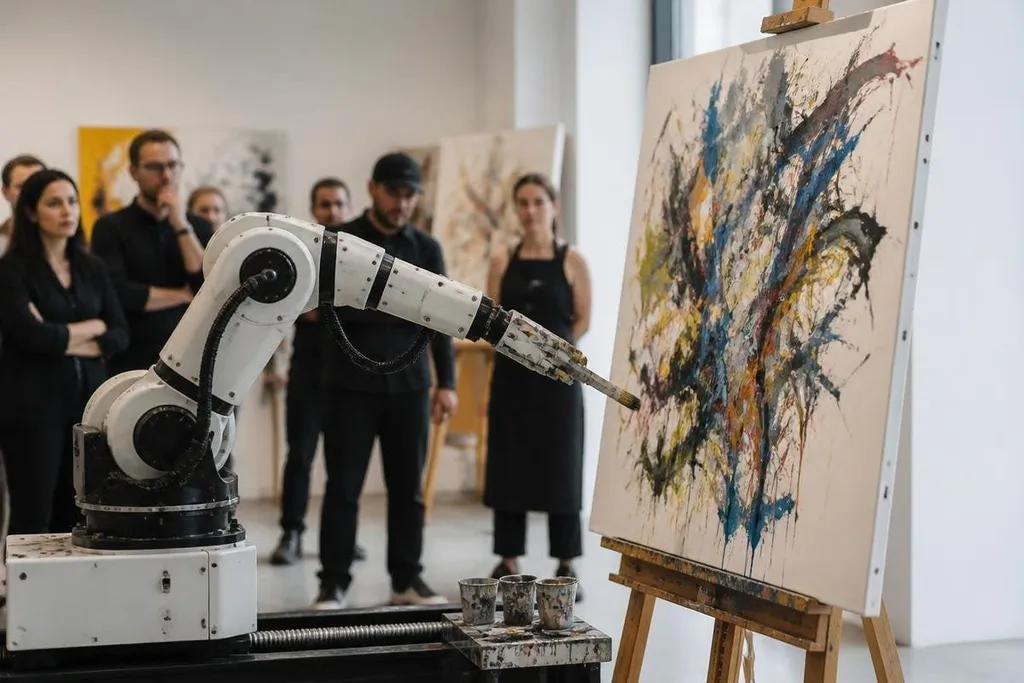
A robot that makes art gives people something to judge with their eyes or ears. That makes the technology easier to discuss than a robot hidden inside a factory, even when the system behind the work is hard to explain.
- The output makes the machine’s role visible.
- The human contribution remains part of the result.
- The biggest questions concern control, credit, and repeatable work.
The work is easy to see
Industrial robots often spend their time on tasks that look ordinary: placing parts, checking surfaces, or moving boxes.
The art robot produces an image, sound, object, or performance that people can examine at once. The result gives a public audience a direct reason to ask how the machine made it.
That visibility changes the conversation. A factory robot may be judged by cycle time, error rates, and maintenance cost. An art robot also gets judged by shape, color, movement, or sound. Those details invite a reaction before anyone knows the robot’s model, software, or sensors.
The label covers several different systems. One robot may move a paint tool across a surface. Another may use software to generate an image, then send instructions to a printer or mechanical arm. A third may perform a programmed motion while a person controls key parts of the process.
Those systems produce different kinds of work, so “robot artist” needs a closer look. The machine’s physical movement, the software’s output, and the human’s choices should be described separately.
The human role stays in the frame
People pay attention because the work raises a question about authorship. If a person selects the subject, edits the result, and sets the limits, the robot may act as a tool. If the system chooses its own actions from sensor input, the machine has a larger role in the finished piece.
That division matters for anyone building or buying an art robot. A system that repeats a fixed motion may be reliable for a gallery display. It may be a poor fit for work that needs fresh results each time. A system that changes its output may draw more interest, but it also needs tighter checks before each piece goes on display.
The person running the system still carries practical duties. They need to set the task, check the output, protect visitors from moving parts, and explain what the robot did. Those steps give the audience a clearer account of the work than a label that credits the machine alone.
I think the strongest robot art makes the division of work plain instead of hiding it.
Attention does not prove useful output
A striking result can show that a robot completed one task. It cannot show that the process works every time, costs less than a human-made process, or runs safely around visitors. Those questions need records from repeated runs, not one finished piece.
The practical test is repeatability. Can the robot make the same form again? Can it respond to a change in material or room layout? Can a technician fix the system when a motor, sensor, or tool fails? A public display may answer none of these questions.
A finished robot artwork needs a record of the work behind it. A report on robot artists and their tools can connect the piece to the robot, software, tool, and working conditions that produced it. That record sets up the cost question: how much of the result came from the robot, and how much came from the people around it?
Cost also shapes the value of the project. A robot used for one exhibition may need a different setup from a system that makes pieces for sale each week. The machine, gripper, paint tool, computer, safety barriers, and staff time all belong in that calculation.
The limits are part of the story
Robot art has limits that are easy to miss in a finished image or video. A camera angle may hide manual setup. A short performance may avoid the conditions that cause a motor to stall. A polished object may say little about the hours needed to prepare the robot.
Legal and social questions add another layer. A team may need to explain who owns the result, which source material shaped it, and how much human work went into the final piece. The answers depend on the system and the rules in the place where the work is shown or sold.
The open question is not whether a robot can produce something people call art. It is how much control, choice, and labor sit behind each result.
A practical check before you take the work seriously
Use these questions when you see a robot art project:
- Name the action: What does the robot physically do from start to finish?
- Separate the inputs: Which choices come from a person, software, or sensor?
- Ask for repeat runs: Has the system produced similar work more than once?
- Check the setup: How much manual work happens before and after the robot runs?
- Price the process: What equipment, staff time, and repairs does each piece need?
A robot artist deserves attention when the work and the process can be examined together. The next useful report will show the machine running repeatedly, name the human decisions, and give the cost of making one finished piece.